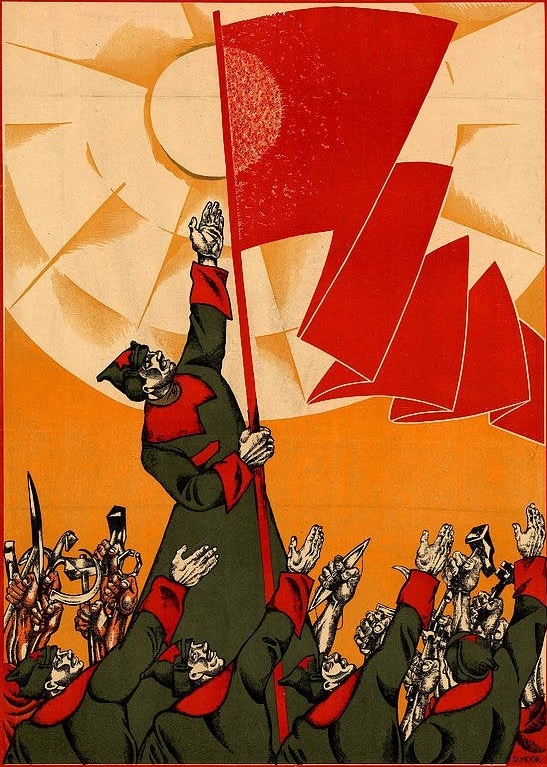
The overarching goal of communism is for laborers to own the means of production instead of an owning/capitalist class. Employee owned businesses are the realization of communism within a capitalist society.
It seems to me that most communist organizations in capitalist societies focus on reform through government policies. I have not heard of organizations focusing on making this change by leveraging the capitalist framework. Working to create many employee owned businesses would be a tangible way to achieve this on a small but growing scale. If successful employee owned businesses are formed and accumulate capital they should be able to perpetuate employee ownership through direct acquisition or providing venture capital with employee ownership requirements.
So my main questions are:
- Are organizations focusing on this and I just don’t know about it?
- If not, what obstacles are there that would hinder this approach to increasing the share labor collective ownership?
In terms of communism, as dreamt up by Marx and Engels, you can only turn a completely capitalist economy into a communist one. This has never been achieved, shortcuts have been taken. All communist states in existence have either turned authoritarian or to dust. So in my view, there aren’t many communist movements left in the world. They may use the word but either M&E wouldn’t like them or they don’t really have a lot of support behind them. No support, no money. Capitalists have a lot of money. People with a lot of money tend to have the ear of their leaders. If an investor is interested it’ll be real hard to go for an employee-owned model (excluding models with free publicly traded shares). If investors are not interested, the business may be failing and employee ownership is the last hurrah before the end. Capitalism tends to come up on top.
This is generally wrong. Marx and Engels believed Capitalism itself prepares the foundations for Socialism, but not that revolution had to wait for Capitalism to fully develop to succeed. Socialist governments can oversee economies and build towards Communism without needing to be fully developed Capitalist states before the revolution. As a result, Marx and Engels would support historical Communist movements like Cuba, the USSR, PRC, etc, especially if they had lived to see Capitalism turn to Imperialism, shifting revolutionary pressure from the most developed countries to the most Imperialized countries.

to mythologise a human.
Ramen truly is the people’s food
The idea for a lot of communist ideologists is we don’t need these hyper competitive corporations. The end goal isn’t “higher GDP” (or more salary), it’s “better quality of life”. I think most unions are like that.
I understand the sentiment. I’m wondering about the efficacy of the strategies to achieve those end goals.
You’re proposing socialism.
Communism wants central authority.
Thats so funny because you have it completely backwards. Communism, the end goal, is a moneyless, classless, stateless society in which hierarchy has ceased to exist. State socialism or “the dictatorship of the proletariat” is a interim step on the path to communism that aims to eliminate class and the social structures that perpetuate it.
Hierarchy would exist even in Communism, at least in Marxist conceptions. Class would not exist, but it won’t be until an extremely developed, extremely late-stage Communism where all distinctions in the division of labor can genuinely be moved beyond, well after class has been abolished.
I think long term we could find a place for those who wish to live in a decentralized commune free of hierarchy. I understand that the centralized vision of communist human progress essentially requires hierarchy but I think we will progress to a point where that becomes undesirable for a large amount of people. Eventually we will reevaluate what it means to even progress.
It’s more that eventually, in the far far future, as technology advances we may be able to erase it once and for all, but there’s no basis for being able to do so without it.
Therefore, socialism should be the ultimate aim.
I truly believe a mixed economy is the answer.
All economies are mixed, the difference in designation of “Capitalist,” or “Socialist” depends on which aspect of the economy is principle, private or public. Communism is a post-Socialist society, a highly developed form of Socialism where private ownership becomes redundant and economically unviable.
Socio democracy and I’m onboard.
Social Democracy is just Capitalism with welfare, all of the “good” Social Democracies in the eyes of Social Democrats like the Nordic Countries depend on Imperialism to function and are seeing sliding welfare and worker protections as a function of being dominated by Private ownership.
America chose the route of social security and a mandated minimum wage instead of the state seizing the assets of robber barons and returning them to the communities that were responsible for their success.
You can see today exactly how well that worked out for the working class: minimum wage is below the poverty line and hasn’t been a living wage since the 70s, social security is being undone, and the government regulations that mandated a standard of living for working class Americans have been entirely dismantled.
This is the result of leaving the power within the capitalist class and allowing them to get away with their abuses without punishment: they do it again as soon as they get the chance.
Socialism IS democratic production, thus the political systems can reflect as such. Maybe more regional control, as I’m led to understand the Swiss cantons function like. Please correct me if I’m wrong.
The Swiss model isn’t Socialist, but I may be misunderstanding your comment.
It can’t be, really, as Socialism either progresses to Communism or backslides to Capitalism.
communism is literally the final goal of socialism.
isn’t that anarchy?
yes, anarchists want communism straight away without going through socialism first.
mostly because they identify the state itself as the main problem, not capitalism or imperialism per se. socialists view this the other way around.
That’s two different definitions of Communism. Anarchist Communism can be likened to Commune-ism, ie a decentralized network of communes, while Marxists want Communism as a fully publicly owned and planned global economy, one that requires centralization.
Ah, gotcha. Thanks so much for clearing that up for me.
No problem! It’s a common misconception, even among Marxists and Anarchists, that both want the same exact society on a different time scale, when in reality it’s not really the same thing at all. Both are responses to Capitalism, but in different directions.
I mean kind of yes but most people would not call them synonymous
Imagine believing you can defeat capitalism without central authority.
Imagine not recognizing that central authority is the problem.
Central authority is a tool. In different hands it does different things, but if you disarm yourself you’ll lose.
If you do not choose your leaders they will choose themselves. We tried the whole leaderless, decentralized anti-authority thing throughout the 2010s. At best you might be able to collapse the central authority of the currently existing government regime, but what comes after that is always much much worse: civil war, invasion, or an even more repressive government regime. But, more likely, the movement will just collapse because it lacks the structure to actually sustain itself.
We need to be centralized and we need to be ready to assert our authority when the old one is destroyed, or we will lose.
Ok so lets say you get rid of the central authority in one fell swoop. What happens when the millions of people who really really benefitted from that authority or atleast believe themselves to benefit decide they want it back. Can a decentralized stateless society truly win political or military battles against them? I can tell you from history that everyone who has tried this eventually resorted to their own centralized authority in order to survive, failed, or both. Communist do not see centralized authority as good, we see it as a means to survive.
You know how a certain faction in the USA keeps screaming about "states rights?”
In my view, central and decentralized authority have their issues. And here come the down votes. The way the Russian voting system was explained to me by the good people of .ml makes a lot of sense and circumvents the worst issues of both.
Russian meaning Soviet, or Russian meaning the current electoral system? Very different.
Thanks for holding my feet to the fire. I believe current, but I could be mistaken, it’s been a long time since I read it, so forgive my sketchiness, but each region having elections until one person wins a final vote, to represent their constituency. I just checked Wikipedia and didn’t remember the representative voting part, so maybe my bad memory. Is there a post somewhere that compares and contrasts Soviet and Russian models?
Not sure about a post comparing the two, but the Soviet model was more comprehensively democratic, and functioned like this:

Thank you; as always, you’re very generous and informative. I have a friend in the mood to chat here, I will read and probably ask dumb questions later.
Join the IWW.
You’re missing the entire point of government.
The goal of communism is control. It always has been. It always will be.
Why?
Because it is a system of governance designed by and used for controlling humans.
Government owned does NOT mean it is owned by the people. It simply means it’s owned by the people who control the government.
You are very close. Government owned does mean its owned by the people who control the government. 100%. But who controls the government? In the west, government is largely controlled by the wealthy (industry lobbying is an easy example). So then how do we have a government that is controlled by the masses?
This is where the type of government called a socialist government comes in. Communism, on the other hand, is some distant future where humanity no longer has to worry about scarcity, and all ideas of money and state are gone.
So a communist party is named thusly to say “we wish to work towards that goal, but recognize that there are steps required to get there”. For example: increasing the democratic control of a country, both politically and economically, while decreasing the influence of capitalists, whose interests are in contradiction to the interests of those who work for a living (or need to sell their labour to make a living, since labour is the only commodity most of us control).
I think breaking down concentrations of power a returning it directly to those most affected by it on a local basis aligns more with that stated goals. I think utopian communism obscures the attainable and effective ways of morphing the structure of our political reality.
Except how are you going to change society without some form of power, which forces you to use the state? I wouldn’t call it utopian what they were describing, while anarchism to me sounds more utopian. Without the power to defend yourselves, the power of capitalists, current, former, or foreign will destroy you.
Mores against concentrations of power, the folk wisdom to spot and unwind them and a taboo against abyone concentrating inordinate power onto their persons. A rejection of collaboration with those who wield leverage to orchestrate others intobdoing their bidding. A taboo against the trade of a human’s future labour profits. A taboo against non-working shareholders or any third party get a cut of profits. Destroy stock markets.
The people who control the government in Capitalism is the Capitalists, the people who control the government in Socialism is the working class, and the people who control the government in Communism is the people. That’s the point of Communism.
Lol no its not.
stateless
There would be what we would consider a “government” in Communism, just not a “state,” ie heavily militarized police to resolve class contradictions in the favor of whoever controls the state, the workers or the Capitalists. Anarchists want full horizontalism, Marxists want full public ownership.
In my country, the communist party (very watered down version of communism but still) is behind/aligned with most unions and they defend that companies should either be owned by the employees (co-ops) or employees should have a stake and saying on companies governance.
We have another left-wing party that even defends that failing companies should be returned to the employees, with government backed funding (loaned) if necessary to recapitalize the business and relaunch the company under employee governance.
I think communists and socialists and anarchosts and broadly leftists do argue for cooperatives and workplace democratisation.
The reason they maybe don’t do it enough is because those businesses in our present environment will get beaten by exploitation mostly.
Co-operatives by nature will sacrifice profit for employee conditions because they have more stakeholders (and shareholders) to be accountable to. Lower wages through exploitation will tend to reduce costs and allow the capitalist businesses to drop prices, and outcompete opponents and secure more investment capital due to higher market penetration, which will allow them to invest in their business, incl. Marketing and product development, and outcompete the more fair sustainable business, until they corner the market and can jack up.the prices and bleed consumers dry and push for laws/lack thereof to exploit employees and cut costs further.
I don’t agree with this. Shareholders extracting value from a company is arguably more of an ‘inefficency’ than treating employees fairly. Well treated employees provide a benefit to the company while shareholders purely remove resources.
I have no data to back up my claim, just logic, so I could very well be wrong.
Shareholders extracting value from a company is arguably more of an ‘inefficency’ than treating employees fairly.
Their pals also owns all media and all economists so they will outright lie to everyone about it. Capitalism at this point in development when even capitalist themselves gets alienated from their own capital loses every advantage and usefulness for developing the productive forces.
You got a point there, and there may be a lot of data to prove that point.
I am part of a housing cooperative (“Wohnungsgenossenschaft” in German), and these cooperatives are noticeably cheaper because they are owned by the members/renters and don’t have to generate any profit, just enough excess money to build new homes. The principle is very convincing if you live in it and save loads of money every month. The cooperatives employees aren’t overworking themselves, too.
Awesome! Where can I read further about this endeavor?
Look for Wohnungsgenossenschaft or Wohnungsbaugenossenschaft. They are relatively common in Germany and Austria; Vienna is an example where the majority of flats are owned by such cooperatives. In Hamburg roughly 14% of all flats in the city are being provided by cooperatives which has huge advantages for those who get to become members.
All sources I know are in German language so if you want to read further just go for these texts and translate them into your mother tongue. Maybe start with Wikipedia:
I saw it happen with Walmart, Ace Hardware, Pizza Hut, Lowe’s/Home Depot. We used to have independent supermarkets too, who set their own prices based on local conditions. I live in an area where the supermarket in a nearby town (it’s really a village) often has lower prices on produce and meats. The big national brands cost more, and this store doesn’t get bulk discounts like Walmart, HT, and Kroger! The problem is I still have to go a few towns over to get decent coffee because Folgers, Maxwell House and Staryuck isn’t it, so when I get a ride, I have to buy extra and freeze it. The local independent store doesn’t have as good starting pay or benefits, though, but without their store, many of our older population would be in serious trouble. An elderly man kept me for some time in the meat department of our chain store because he said he was ashamed to be looking at low quality beef at those prices, when he used to farm and hunt his own. Years of farming to feed our country left him with hands that don’t work the way they used too. I didn’t buy their overpriced products, and felt bad for someone who destroyed their body for people who largely don’t even consider that nature gives us her body and blood for us to eat and drink, and from showing, weeding, irrigating, harvesting, processing, packaging, shipping, stocking, dusting, sweeping, waxing, checking, the individuals who suffer and destroy their bodies to get it to the table.
I was in another independently owned grocery a few towns over by happenstance to pick up a few things while accessible. In less than 15 minutes, because I didn’t know where items were and asked, three different employees told me to wait, they’d be right back. I guessed they were asking or making sure. Each returned with the specific item I wanted, to save me steps! Again, every item but one was less expensive than the chains, and I am guessing they can’t compete with chain grocery starting pay, either.
Interestingly enough, the employees do get a small profit sharing incentive.
Cooperatives tend to be more stable than traditional firms, but they are both harder to start, and aren’t Communist. OP is confusing worker-owned private property with the abolition of Private Property, Communists don’t focus on worker cooperatives because cooperatives retain petite bourgeois class relations.
Rather than creating a society run by and for all collectively, cooperatives are a less exploitative but still competition and profit-driven form of private business. Communists wish to move beyond such a format, even if we side with cooperatives over traditional firms when available.
Something something they do sometimes
- There are efforts to build emoloyee owned businesses around the world
- The system is pitted towards accumulation through psychopathic behavior which is absent in democratic companies, hence they’re disadvantaged
- Communists and anarchists are revolutuonists, not reformists. The reason is that reform makes the inherently cruel system easier to bear and abolishment less likely.
- Some want to go the reformist route to try if it is actually achievable
- Most importantly and very evident in the US: 100 yrs of reform can be rolled back in one day. We’re seeing that reform is pointless.
Most importantly and very evident in the US: 100 yrs of reform can be rolled back in one day. We’re seeing that reform is pointless.
It also means swinging the other way takes a day. (Unlikely, but now far more likely than before.)
Absolutely not. Progressive politics arent easy to understand and need vastly more effort to implement than regressive politics. You’re arguing completely against history.
No they aren’t. A number of proposals have been kicked around for decades. There hasniot been the will to implement.
Political Economy is material, not based on the willpower of individuals. Reforms are hard to get because the ruling class doesn’t want them, and they control the levers that can enable them in the first place, hence why revolution is necessary.
A number of proposals have been kicked around for decades. There hasniot been the will to implement.
That’s the point. A dictatorship of the bourgeoise will not implement progressive policies unless you fight hard for them. They will however, in the absence of resistance, implement increasingly reactionary policies in a heartbeat.
In that case I suggest a history class.
There have been bloody protests over a long time, people died, there even was a revolution in france.
All for some small changes that are absolutely logical.
Now germany for example is reverting the 8 hr workday without any protests needed.
The ignorance of people is insane.
If conservatives can shape society with executive orders, progressives can as well.
Shaping change grassroots is great, but progressives don’t need to be bound by different rules than conservatives.
Edit: toning down my rudeness.
But again thats only technically true. There are no progressive majorities and fascist billionaires are manipulating the masses. Misinformation is ruling the discourse. What you’re sayibg is factually impossible at this point in time.
This is both rude and ahistorical, laws are passed based on what the ruling class wants. The ruling class cannot abide Socialism unless the Proletariat becomes the ruling class through revolution.
Watch your rudeness if you are going to be confidently incorrect.
Employee owned businesses are the realization of communism within a capitalist society.
Right, but we want the whole system changed. Coops are inherently at a disadvantage in monopoly capitalism.
What?? Why would an organisation free of parasites, not trounce the “meritocratic” system?
Because they cannot compete with the economies of scale, the availability of capital, market power, an exploitable workforce, etc.
It’s like asking why you can’t win at checkers when your opponent is cheating at 4d chess.
Read: Imperialism, the Highest Stage of Capitalism by Lenin
Well creating an opposibg empire didn’t work out so great.
Capitalism is a belief system, you can’t beat ideas with guns.
There’s not going to be an anti-imperialist empire that successfully ends imperialism.
It exist only because it’s population is cajoled into accepting it as the only viable, profitable option.
Concentration of power is the social disease, it creates a “all the eggs in one basket” situation where one bandit can seize control of the whole.
It is a strange paradox that a society built on individual responsibility would be corrupted and usurped by its cooperation mechanism. And that the path to a semblance of decency is to cut down on cooperation to disempower those at the grotesque top.
And then maintain taboos to prevent tge concentrations fromvforming again. BECAUSE they are too profitable and power.
Make CEO a crime, make presidents weak, cut off the heads of kings.
The more we get, the better it becomes. Trying to just change the whole system at once is just an excuse for not making the small changes that move the needle.
Do find it interesting that every anti-capitalist society was achieved through revolution? Not by voting or incremental changes, but by ugly, violent, revolution?
By all means go and create some coops! I became a member of a local food coop. But I am under no delusion that this impacts capitalism whatsoever.
Capitalists aren’t going to just let the system slowly change. The mass murder campaigns waged by the CIA have taught us that (read The Jakarta Method).
Making more co-ops doesn’t make them any more competitive against companies that exploit their workers for extra profit.
If you can make a successful co-op then go for it. But they absolutely aren’t a path to any sort of revolution, which communists are all about. Forming a labor union in a critical industry is a much higher priority for communists than starting another co-op.
It isn’t communism, but sometimes making a co-op turns out to be more successful than forming union inside fragmented industry. A prominent example is amul from India. Instead of of forming union against highly capitalistic dairy industry, milk farmers and workers made a co-op that replaced those capitalist industries with market force.
The point was though this initiative got direct support from the government not some agenda against it.
The government funding is really key here. We would be seeing communists constantly starting co-ops if seed money wasn’t a barrier. That’s not to say co-ops would be successful.
Small, local communist Ws would enable more state and national communist Ws.
“Well, that co-op just outside of downtown is doing fine. Molly’s daughter worked there when she was in high school and said it was the best job she ever had. I guess communists can do some things right.”
is an improvement over
“I’ve never met a communist, but I know they’re all stupid and evil. I’m going to vote against anything with the word socialist or communist next to it because [media personality] told me so.”
I’m not convinced of this. One could argue that profit is waste. It’s an overhead of wealth delivered for value provided. If co-ops are less incentives towards profit, e.g. by not having a tradeable stock to manage, then the pursuit of profit is a lesser priority. This means the overhead is less, which could mean lower prices.
To put it bluntly, if you don’t need to pay dividends to shareholders who deliver no value or huge bonuses to executives at the top, maybe the operating costs could be lower. Yes, the cooperative members would take some of that money as profit sharing among the members, but the working class tends to be less sociopathically greedy than those in power.
Definitely open to feedback. This kind of thinking is newer to me
One could argue that profit is waste.
Its not, its profit. Dividends to share holders are interest payments on vital loans which co-ops don’t have access too. Those early investments provide more of an edge than not having to pay them. Otherwise firms wouldn’t bother with investors at all.
You could say excessive c-suite salaries are a waste. But those high salaries gets you the absolute psychos who will squeeze more excess value from the workers than any co-op could. Co-op workers wont be as greedy with wages or benefits, but they will absolutely look to cut their workload and get more free time (actual freedom).
Part of being a Marxist is accepting that the capitalist theory of profit motive applying to everyone is true. Its not universally true to everyone in every instance. And its certainly not a moral imperative like capitalist ghouls believe. But when we’re talking about statistics and large populations it absolutely does hold.
Sorry my ignorance is showing here but I thought coops might be stronger than a company in a way they have more staying power before a company is forced to enshittify. I naively thought people would recognize the better quality of stuff provided from coops because they don’t have to fulfill the shareholders dreams of line must go up.
I think you already read the reason/s but in a monopoly capitalist society, but companies can just smother smaller ones by leveraging their exploited workforce (more output for less cost), out-competing, buying up all competition, much better economies of scale, and access to capital and market forces.
Just take an example of a small business owner who sells sporting goods (I use this example because I love Freak and Geeks lol). How can you possibly compete with Walmart when Walmart has bigger and better inventory, cheaper prices, more locations, basically no competitors, better advertising, etc? Sure lots of people value ‘small businesses’ from a moral/ethical point of view, but enough for this company to grow and grow and grow and compete with friggin Walmart? That just doesn’t happen often.
Now, something like REI, which is a coop, does compete with Walmart in a very niche market. REI has a strong brand and loyal customer base, allowing it to compete effectively in the outdoor and sporting goods sector. However, its focus is more on quality and specialized products rather than mass-market items. Do you think Walmart couldn’t just destroy REI if it felt like it was being threatened and it wasn’t one of the largest mcap companies on the planet?
Right, appreciate the write up.Dammit lol
REI is not a workers coop. It’s a consumer coop. It’s not even the same thing. The fact that it’s so difficult to even find a workers coop that is a national retailer shows you exactly why competing as a coop on the capitalist market is difficult.
Yep, good point! I was trying to think of examples. Ace Hardware isn’t a workers coop either.
It’s really hard to generalize about leftist groups. The communists that feel this way have formed co-ops, or are cooperating with anarchists to do something like syndicalism (focused on unionizing existing businesses).
But the methods to start and grow businesses in a capitalist country inherently rely on acting like a capitalist. Getting loans requires a business plan that makes profit, acquiring facilities and other businesses requires capital. Local co-ops exist because they can attract members and customers that value their co-opness, but it’s very hard to scale that up to compete at a regional level. It’s not impossible, but it’s hard to view it as an engine for vast change.
Communists that focus on voting are delusional (in my opinion) but like all reformists they view the existing government as the mechanism to make widespread change.
Huh. Someone I know is trying to start a business with a longer-term aim of a co-op. Business insurance for themselves is going to run 30-40k minimum per year!
Perfect example. Insurance is an entire industry of blood sucking middle men producing absolutely nothing.
Good luck to your friend. Sorry they have to support a useless leech corporation instead of, you know, paying that money to actual workers.
Communists that focus on voting are delusional (in my opinion) but like all reformists they view the existing government as the mechanism to make widespread change.
The only state in my country that has a communist party in power has been consistently leading national rankings in education and health, so I guess they’re doing something right.
Hey, that’s great. I’m not sure it’s a way to reach full communism, but good on them.
I think worker cooperatives are sometimes bashed too much but worker cooperatives are fundamentally a lower petty-bourgeois form of organizing. Cooperatives can only be an ally to the movement of the proletariat and not a driving force. That said, they might have minor use.
I have been thinking about how to sublate the lower petty-bourgeoisie into the movement of the proletariat. I think it would be cool for a bunch of workers in a worker’s state to make a worker cooperative as a startup, make it big and then sell the cooperative off to the worker’s state. As long as the land and the banks are owned by the state anyway, the worker cooperative would be financed and largely owned by the people indirectly anyhow.
But in terms of pre-revolution, worker cooperatives may help educate the workers who are part of it, and cooperatives can help ease the transition of class suicide for petty-bourgeois and labor aristocracy class traitors.
There’s a bit of a trouble for educating the workers compared to unions due to the class situation and nature of ownership. But I think it would be less harmful for a small business owner to create a cooperative than to go out of business during an economic bust and with unexpected declassing become a reactionary blaming their debt on minorities.
I think the trouble is where to focus the limited time and effort of the communists. It’s not that cooperatives are bad necessarily, it’s just that it’s more helpful and important to focus elsewhere.
I do think some communists get weird about strata other than the proles proper such as the reserve pool of labor, lower petty bourgeoisie and the labor aristocracy. The foundation of the communist movement should be the proletariat but these other strata are not inherent enemies. There’s not a fundamental antagonism of exploiter and exploited here.
If you’re vegan you don’t decide to eat chicken just because chickens don’t eat meat. They’re still chickens.

What he means is the commulists still want to dominate workers for their own good, when they say “own the means of production” they are not going to let the actual workers do the owning. The commulists will own tge means of production on behalf of the workers instead of the current parasites.
Cooperatives would put the actual power in the hands of the workers and would stop external forces from directly interfering into their affairs and telling them how to work or what to work on or why.
Wanting an economy run democratically by all of society for all of society, rather than have an economy made up of small competing cells that each want to further their own interests at the expense of others, is a reasonable thing. “Domination” has nothing to do with it.
If only they remained small competing cells. But nearly always grows more and eat the others. Then the big cells say they have to make their employees piss in bottles to survive. They use the arguments of what small cells do to survive to justify the business model that made them huge and allowed them to kill all the small cells.
It’s an arms race dynamic of cut-throatedness where the biggest bastard is favored to win.
What a shit system. What a terrible and disgusting infection of the human mind.
Yeah I don’t understand the metaphor, either.
I suspect a big part is tax and investment law.
A bunch of poors (like me!) who band together won’t have much capital to buy inventory or equipment. I doubt banks and investors would lend to the bunch of poors, since they have a non-standard decision making structure.
That’s gonna make it hella hard to get started.
Hard to get started, and not Communist, either. OP is confusing worker owned private property with the collectivized system of Communism, hence why though Communist orgs support cooperatives as less exploitative than regular firms, neither is the basis of Communism.