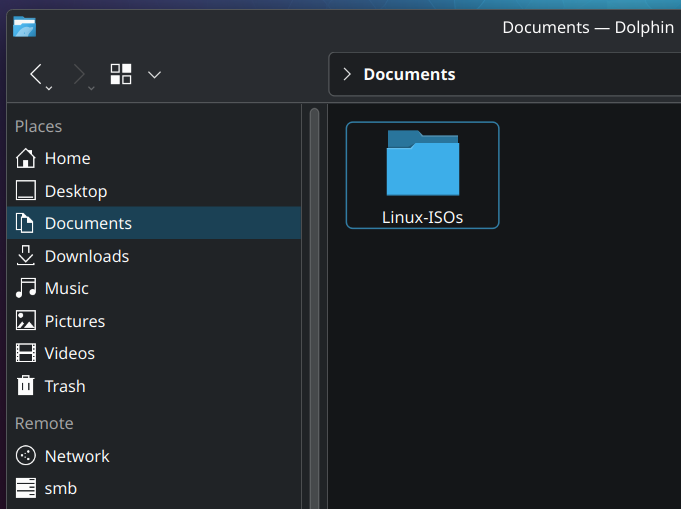

So it begins.
I’ve been flashing my USB often enough that it’s now worth it to keep all my ISO’s neatly to use them when I need them. I plan on buying 10 USB sticks to just have ready when ever I need a specific version.
I’m visiting family now, so time to upgrade their Linux Mint to Kubuntu
Uh… you do know that people don’t literally save a bunch of Linux ISOs, right? It’s a euphemism for collecting less legit things, like pirated media or porn.
By the time you want to install the same distro again, it’s likely that a new version will be out and you’ll want to re-download it anyway.
You’re right, but I’m still saving them anyway◝(ᵔᗜᵔ)◜
Speak for yourself. I have ISOs saved for my virtual machine “OS Museum” full of all kinds cool stuff like Damn Small Linux, TempleOS, Haiku, Hannah Montana Linux, the version of Mandrake Linux that came with the Sims 1 installed … Etc.
Objectively a good reason to store ISOs
You can always just use the version you have and run an update after it’s installed.
551GB of ISOs here. Most are very old.
If I saw that folder name while using a friend’s machine I would know not to click on it to respect their privacy.
Anal-LTS-x86-64bit.iso
10 USB sticks? why? just use ventoy and throw them all on an external SSD or something. that’s what I do. can even use that with specific dotfiles you need for each distro along with ventoy. much easier to deal with than 10 usb sticks.
What’s wrong with Debian?
The latest version of anything is at least 6 months old.
Stability over everything is pretty awesome.
I think that term gets confused frequently in this context. Stability as the Debian likely uses it means mostly static APIs. Meaning a stable interface to develop software against.
The way the users mostly understand it means stable software, no major bugs or crashes.
And while those two are linked, they’re not the same. Anecdotally, I’ve used Arch for over 10 years and had only three breakages. Two because I forgot to check for manual intervention before upgrading and one because the battery of the laptop died during an upgrade. All were easily fixed from a live environment, no reinstall necessary. Yes, there were bugs and even crashes in software, but those were upstream issues. I admit that’s not a distinction a user is likely to make. I still consider Arch the most stable distro I’ve ever used.
Are they Linux ISOs or “Linux ISOs”?
I don’t mean to crash the party, I used to love Ventoy too. But then the blob issue came up and it was met with silence for over a year by the maintainer, that made me a bit uncomfortable. They have responded to it a while ago, but it’s no trivial task to solve as I understand it: https://github.com/ventoy/Ventoy/issues/3224
@Ek-Hou-Van-Braai Did your family request to switch distros? If not, you are not their friend and not doing them a favor.
Your family will hate you if you’ll change their distro and DE every time you visit them. Distro hopping is normal for the first couple of years, but do it on your own machine.
I’ve been using Linux for like 18 years and I still hop. I got a better idea of what I like to use for different situations though…but there are so many great builds/derivatives now. I’m pretty well settled into Bazzite and Nobara, or regular Fedora and Fedora Blue, depending on specific needs now though.
First couple of years? I was in my early teens when trying out many distros within a couple weeks, for example Puppy Linux, Ubuntu, Edubuntu, Ubuntu Netbook Remix, OpenSuse… Then I settled on Ubuntu and used that from 2008 to 2022, when I was fed up with Canonical shoving snapd down my throat and me having to uninstall it all the time. Since then I’ve used Debian exclusively, previously I only had it on some machines.
(I’ve also toyed a bit with the BSDs, but was missing systemd, so those never stuck with me.)
what is bsd?
ive heard of it, but not really seen or used it
Several different operating systems, such as FreeBSD, NetBSD, DragonflyBSD (the latter one having a live system and being the easiest to try out). Those have their history based in BSD. But thatʼs all bit too much to fit in s reply here.
Unlike Linux distributions, those projects develop a kernel and the other parts together and make an OS.
Most software will be available on BSDs and on Linux distributions.
So kinda like linux but not linux?
Linux and BSD have the same heritage, but took slighlty different paths… so they’re cousins.
Look it up on Wikipedia, etc… it’s an interesting bit of history.
UNIX was a proprietary operating system developed by AT&T that was originally shipped with source code.
BSD started as a set of enhancements to UNIX at Berkely University.
BSD developed into a fully independent UNIX distribution. BSD code was available for free and always non-proprietary.
In the early 90’s, AT&T launched a lawsuit to stop BSD from being distributed.
During that lawsuit, in 1991, Linus Torvalds created Linux. It was written from scratch to be like UNIX as Linus liked UNIX but could not afford it.
In 1993, BSD won its lawsuit and FreeBSD was born. But by then, Linux was already getting lots of attention. FreeBSD, while technically superior at the time, has never caught up in terms of popularity.
Linux uses the “design” of UNIX but is not UNIX. FreeBSD is considered “real” UNIX. Both implement the POSIX standard.
FreeBSD has always been focussed on servers. There are other BSD “distributions” that focus on different things: OpenBSD (security), NetBSD (portability), DragonFly BSD (innovation/performance). Some people consider macOS to be a BSD.
There are also “desktop” spins of FreeBSD like GhostBSD or MidnightBSD. FreeBSD recently has had more of a desktop push focussing on things like WiFi and power management. But it has nowhere near the hardware support that Linux has.
Linux, technically, is not a full operating system. It is just a kernel (the bit that talks to the hardware). The Linux kernel is released at kernel.org.
Linux “distros” collect a bunch of software to run on the Linux kernel to create a Linux distribution (full operating system). This includes key components like C library, core utilities, compilers, and init systems. Many Linux distros use software from the GNU Project for these components. But other Linux distros use non-GNU software for this, sometimes even software created by BSD.
As others have said, the BSD systems are built as an entire OS by a single team. FreeBSD 15 was just released. The entire software stack was created as a unit, including C library, utilities, compiler, and init system.
IRed Hat Linux is kind of developed as a full operating system as well as they are heavily involved in the kernel, are the primary contributors to the GNU tools, sheppard GNOME, and created Systemd. You could argue that Red Hat is the de facto Linux platform and that others distos build off that. But not everybody would agree.
So, Linux is more like UNIX but not UNIX (created in 1991) while BSD is UNIX (in continuous dev since the 70’s).
As a desktop OS though, Linux is substantially more popular than any BSD and so, these days, the tables have turned and the BSD variants often have to work to stay compatible with things that appear first on Linux.
Remember to keep Hannah Montana Linux too!
Install Temple OS on your mom’s desktop
Wow, just looked that one up on Wikipedia… just… wow
Just buy 2.5 HDD put it in USB sata case and use as USB stick with ventoy
Or if you want to install an entire iso in less than a minute, one of these.
I really like that one. I can move a terabyte in minutes, and unlike some other M.2 enclosures, this one is a heatsink sandwich, which enables sustained full-speed operation.
Buying m2 nowadays or any ssd is not cheap thing at all
True. But if you have an old one laying around, from a laptop, desktop or whatever, even a low end one will saturate usb while beating 2.5" hdds.
It may not work. I have two ssds like that and they both won’t boot ventoy for some reason, but a hdd in a usb case worked no problem.
Also, unless you’re using the usb3 interface it doesn’t make much difference really.
I’d recommend a HDD enclosure with a virtual drive emulator. I personally use this one which I’ve had for about a decade at this point. Lovely device. At some point I think I’ll pop an SSD in it instead, mostly just for durability purposes.
Use Ventoy, you can have dozens and dozens of ISO on one stick only, when you boot on it you can select the one you want.
The drawback of using Ventoy is that it doesn’t support systems that has too old BIOS installed. Otherwise it’s great.
I can assure you, you will never need them.
I got a USB stick with ventoy installed, got a gparted and an arch linux iso on that thing, I do use those regularly.
Ventoy for most, but some stuff doesn’t work with correctly when booted from ventoy:
-
ChromeOS Flex won’t install to internal drive when ventoy booted, it will when flashed directly to a usb.
-
also had Linux Mint 22 try to install to the ventoy drive (wiping it and then crashing halfway through)
-
and dealing with really old 32bit bios laptops you’ll have to use direct usb too (AntiX still supports 32bit)
I’ve had issue with proxmox from Ventoy but other than that it’s great.
-
Upgrade Mint to Kubuntu 💀
isn’t it the other way? Ubuntu/Kubuntu -> Mint -> Arch-based (Manjaro, …), Arch … -> “btw”
I mostly found it funny they felt the neet to upgrade from mint on a family members computer to anything else, because I can’t imagine mint not already working fine for them.
I fail to see the benefit in “Upgrading” to kubuntu (or anything else) in this case.
But yes u right hehe arch btw but also mby mint btw 🤔
Don’t distrohop too much, at one point there won’t be much more to explore with other distros other than wallpapers and themes
There is always more.
Have you tried Chimera Linux?