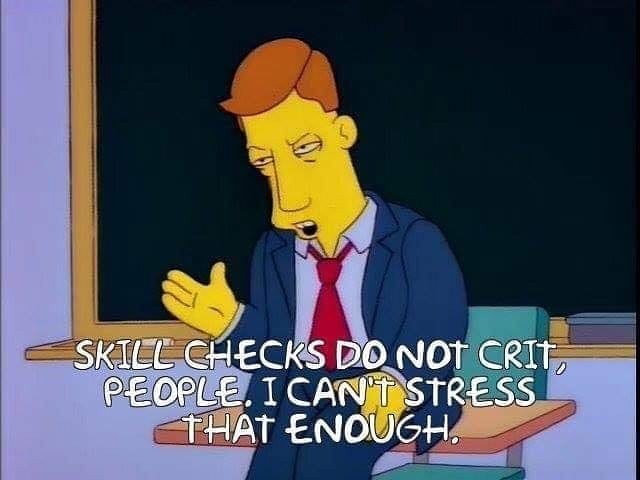

(in D&D at least)
You must log in or # to comment.
They do if it’s funny. Fails too.
*in the core rules.
If you want to homebrew it then go for it.
Rule of cool
If something sounds fun it’s happening at my table.
If you roll a 20 on persuasion or something we’re going to have fun, but I’m not turning characters into literal gods (though that did happen one game)
If the players are demanding wild results, especially if they’re the kind to roll unprompted, then sure.
But in my experience, it’s usually just a little flourish or a small bonus, which I think is fine.
And if the issue is that a nat 20 doesn’t guarantee success, technically, sure, but I’d be more annoyed being asked to make a pointless roll. I know there are reasons, like a hidden target number, or other characters being able to do it, but in general, I’d rather just hear “no” than go through a pointless check.
Depends what system you’re playing
They absolutely do, and the bonus effects are listed in the description of each skill action. Oh. you mean in D&D. washes hands
Dating back to 3rd critical skill checks in D&D suck because a lot of skills are written as pass/fail.
Example: picking a lock. If we want to add criticals, a 1 breaks the lock; mostly okay, with the long acknowledged fringe problem of experts being incompetent 5% of the time. What does a natural 20 get? I adore opportunities to be creative, but there’s not a lot better than, “You did it perfectly.” A regular success earns that according to the rules, I don’t want to take it away. A speech about how cool and ninja the PC is can come off pretty cringey to me. The correct mechanical answer would be to let the 20 roll over to the next check because the PC’s in the zone or whatever. Not awful, but it doesn’t directly reward the player right when they rolled the 20, which is the occurrence we want to feel good. We’re also rewriting several rules at this point.
Meanwhile, PF2e baked degrees of success into everything. On a crit fail they break the lock, on a fail they leave traces of their fruitless efforts, on a success they get one success toward opening the lock while scuffing it up a little, and on a crit success they get two successes and leave the lock looking pristine. The players don’t feel cheated when they get a normal success and scuff up the lock. The 20 has some reward for most characters. The 1 has a setback, even a reasonable setback for an expert with a +25 trying to open the DC 10 lock on Grandma’s rickety shed.
I actually don’t mind pass/fail rolls in D&D or other games. Rolling a 20 is inherently satisfying to me and I don’t mind if not every roll has fifty possible branching results. But I recognize I’m in the minority and I very much like the DC+10 critical threshold because I often like my very high skill bonus giving me additional perks even if I was only moderately lucky and rolled an 18.
Hello fellow Pathfinder!
It’s technically homebrew, but basically every table Ive played at will give you a little bonus if you roll a 20 for a check and a little negative if you roll a 1. But we still kept that a 20 does not necessarily mean an auto success and a 1 is not necessarily an auto failure. You still need to beat the DC
This is the way
Agreed, auto success on a skill check nerfs challenges.
If the DC is so high that the PC doesn’t succeed with a 20, it seems too random to give it to them.
Then again, it depends on the situation: a nat 20 trying to convince the penny pinching tavern owner to give you a discount seems like fun even if the DC should be infinite; but when dealing with something story related, I’d stick a little closer to the rules.
But at the same time, if the DC is so high that no roll could succeed, then they shouldn’t be rolling for it in the first place
You’re right, but I don’t know most of my PCs stats. If the DC on a lock is 21, I’d expect a rogue might make it, but another PC who has never picked a lock wouldn’t.
Worse! At just level 7, a rogue is likely to have +11 and Advantage to pick a lock, which combined with Reliable Talent means they can’t fail a DC 21, and have a 1/2 chance of beating a DC 26.
So if you want there to be uncertainty and challenge, you have to make the DC more like 25-28. Making it all the more likely that the lock should be impossible to the rest of the party.
If I wanted to formally add ability check crits I would make them add/subtract something from your result. Not automatically pass/fail, because the consequences of that are bonkers.
Not automatically pass/fail, because the consequences of that are bonkers.
Agreed
This. You only need dice if the odds are dicey.
I recall a Zee Bashew video that I can’t seem to find that referenced a chart of how willing someone was to help when requested. The idea being the scale isn’t from “I will actively hinder you” to “I will sell my estate to aid you” but rather from less then helpful to more helpful.
For example, if you asked some haggard clerk about a quest the scale might be:
- Critical failure, the clerk directs you to the job board for details on any job.
- Failure, the clerk may point out there specific job on the board and direct you to it.
- Success, the clerk tells you that the person who posted the job is staying somewhere in town.
- Critical success, the clerk may share a rumor they heard in addition to telling you where the poster may be staying.
Regarding a discount from a penny-pinching inn keeper, perhaps it could go:
- Critical failure, payment for the entire stay is required up front. Extending your stay is not permitted.
- Failure, They are not willing to lower their prices
- Success, they will offer a lower price if you bundle extra services like meals, drinks, and baths.
- Critical success, they will offer you the bundle rate without bundling.
For stuff that isn’t story related, and if the group is in the right frame of mind, I’d ham up 1 and 20 on social roles. Nobody is selling their estate, but they might decide they take a shine to the PC or something else that’s fun. Similarly, a nat-1 could get the NPC offended, so they refuse a request grumpily or only help grudgingly.
Otherwise, I think what you’re saying is how I’d play it.
Mutants and Masterminds has (effectively) a +5 if you roll a 20, but no extra penalty for rolling a 1.

20 peasants stand on the edge of the Grand Canyon and attempt to jump across. On average, should one succeed?
While no individual peasant ought make it across, im pretty sure on average, one in twenty people can jump the Grand Canyon
put bards in garbage can. hm makes sense.
In 5e, they do if you like fun. But go off on your “correct” way to play
They do in PF2e. And it rocks
🤓 Pedant mode activated 🤓
🤓 Erm, ackshually, a natural 20 only increases the degree of success by one. This means, for example, if someone rolls a 20 on an attack roll, the total with modifiers is 28, and the defender’s AC is 30, the attack will be bumped up from a failure to a normal success, not a critical success. 🤓🤓🤓🤓🤓
Just because a Nat 20 isn’t necessarily the cause, doesn’t mean that skill checks don’t crit.
You are technically correct, which is the best kind of correct.
To be even more pedantic: the original poster’s meme says skill checks don’t crit, not that nat 20s on skills are a critical success. Most skill checks in PF2e have a critical success tier. Thus jagermo was correct when they said that skill checks do crit in PF2e.
That being said, you are correct about how the whole tiering mechanic works and a nat 20 not always being a critical success. :)
GURPS too
On page 242 of the Dungeon Master Guide 2014, it describes crit successes and fails as an optional rule.
As optional as multiclassing and feats.
It has the same mouthfeel as a crit, I want my wildest dreams to come true every time I see that two zero
Fuck you, Im dm so I get to pick what does and doesnt crit >:(
Exactly. Why not make them crit? It’s going to be up to the DM anyway to define what a “critical success” means on a skill check. There’s no hard rule like the extra damage that comes with crit successes on attacks. The DM gets to choose what a critical success on a skill check actually produces. The DM can easily just make sure the crit success isn’t game breaking.
Your players are in an audience with the king. The bard tries to be funny and tries to convince the king to give him his crown and hand the kingdom over to him. Actually making the bard the new king would break the game. But maybe a critical fail means the bard gets sent to the dungeon to be tortured for daring to make such a request. A critical success means the king will grant the bard one “wish,” ie, any reasonable single reasonable request that is within the king’s power.
The whole situation is fully in the DM’s power.
Ok, but if the 20 doesn’t succed, why did you let them roll in the first place?
Some players don’t ask.
Maintaining the illusion? Not revealing the (impossible) DC?
Because I don’t have everyone’s modifier for every skill, ability, saving throw, and attack memorized off the top of my head, nor do I have magical foresight into whether or not they will choose to use abilities that would add more additional points on top of those modifiers.
I agree. In casual play you can rely on veteran players to know their stats. If they’re the type to lie intentionally then they can leave the table. If they’re making mistakes then maybe something goes a little too easily, oh well. The best DMs i had didn’t give a shit and focused on rewarding players for learning.
No, you’re misunderstanding, I’m not saying the player, I’m saying the DM. I’m not going to waste everyone’s time at the table checking whether a 20 on the die could possibly succeed given their modifier when I can just ask them to make a roll. It’s way quicker.
Ah yeah i see. A roll skips you having to sort through character sheets introducing a silent pause in the narrative to determine whether a check passively succeeds.
I was a little confused by talk of character sheets because the players have them right there and they should be carbon copy with what the dm has.
I meant that for checks as the DM you can save time by relying on players who you can trust to know the game and be honest, rolled or passive. I argue that a DM that asks for my stats has not yet been any less immersive for me. It takes a split second and I’ll take it over railroading every time.
I think most people would say not letting you attempt to do something because they think your character can’t possibly have enough of a bonus to do it is railroading. Again, like I said, I don’t have foresight to know what the bonus might be. What if the bard decides to inspire them? What if the cleric uses guidance before? What if they have some item that gives them a bonus and they haven’t written that in and just add it in the fly?
I agree completely!
Tap for spoiler
I assume you’re just adding context because I don’t believe dialogue has clashing ideas any longer
I’m just disagreeing that allowing someone to roll when a 20 might not be enough is railroading.
You should at least have a general idea of your PC’s skillsets. As in, don’t let the country bumpkin make Arcana checks about monsters he’s never seen, or let the stick figure try to punch down a wall. If you look at a character in a situation and think, “there’s no way that could succeed,” then they shouldn’t be making a check.
Think of it from their point of view though. They want to try and do something. For me to just flat out tell them “no, there’s no possible way” is discouraging and robs them of autonomy. Obviously for crazy extreme circumstances I won’t let them, like “let me convince the king to abdicate to me!” type things. But if I think the DC should be 25 or something I’m not gonna bother wasting my time calculating what the theoretical maximum could be for the roll because I genuinely cannot know. The player can always do things I don’t expect or use other players’ things to help. For reasonable but implausible things I’ll allow rolls even if a nat 20 wouldn’t work because I’m not calculating what a nat 20 could theoretically be.
Plus, I often give people little flavor benefits for nat 20s even if they don’t have mechanical success.
don’t let the country bumpkin make Arcana checks about monsters he’s never seen
Why not? It could be fun! Of course non-critical rolls would be useless, but on a critical failure they could convince the whole party that dragons can’t see movement, and on a critical success they could buy mere chance figure out where its voonerables are (it’s a million-to-one chance, but it might just work!)…
or let the stick figure try to punch down a wall
Again, why not? All rolls, they take a bit of damage; critical failure, they break their arm or hand, and manage to dislodge a brick which starts a comically unlikely and extremely noisy Rube Goldberg chain reaction which ends up waking up and alerting all the guards; critical success, they hit the hidden button that opens the secret door (in another wall), starting a whole new subquest.
Why the hell not? You’re the DM. Why do you not have copies of your player’s character sheets?
I regularly play in groups with eight player characters, Kolkani. Do you want me to check all eight of their sheets and all their abilities that could possibly modify their scores or just ask them to make a Blah (Foo) check check and see what the result is? It’s gonna be way faster for everyone to just ask them to roll.
How do you create fair encounters without knowing your player’s character’s stats? 🤨
I don’t think I’ve ever needed more information than character level and a vague sense of whether that character/player is more or less effective in combat/social encounters than usual to make them. I definitely don’t need to worry about whether they’ve got expertise in history, that’s something they can bring up when I ask them for a history check
Throwing whatever you please at them. It’s fair because they’re informed of the risks and given opportunities to adjust their plans.
Just because I have a sense of what modifiers are and might check during encounter building doesn’t mean I have them all memorized. That’s genuinely like over a hundred numbers to have memorized. Plus I can look at a sheet while building an encounter and not waste anyone’s time.
I never mentioned having them memorized. I specifically said you should have a copy of their sheets. lol
Do you want me to check all eight of their sheets and all their abilities that could possibly modify their scores or just ask them to make a Blah (Foo) check check and see what the result is? It’s gonna be way faster for everyone to just ask them to roll.
I never said I didn’t have the sheets. You keep trying to make this about access to sheets.
Sometimes, it’s about sending a message.
Once in a blue moon, an impossible check can impress a scale of difficulty on the players.
D&D example: a player with a high bonus attempts an Arcana check to figure out an enchantment and rolls well, up to a natural 20. I let the players have their moment of joy. Then I make a big deal of telling them they don’t have any idea what’s up with this enchantment. I really talk up how weird/complicated/confusing/impenetrable the enchantment is.
I’d be trying to prompt emotions I want the players and PC to share. Frustration, inadequacy. The players would viscerally know they need to try a different approach.
And because I gave the check a decent chunk of game time, it has more narrative weight. An interactive skill check is more substantial in the player’s mind than a monologue on the task being impossible, particularly if it stands out because they fail that check despite a super high result.
It’s a niche scenario, I admit. Most of the time just don’t ask for the check.
In addition to what the others have said, I think degrees of failure are often a fun thing to introduce whether they are in the rules or not (I’ll assume D&D 5E). It might be that a 20 with your +3 athletics isn’t enough to completely leap over that huge gap, but you manage to grab a handhold a few metres below the edge. You’ll have to take a turn or two to climb up, but you’re okay. The cleric’s roll of 3 with a -1 athletics, on the other hand, sees him plummeting to the bottom and taking a heap of fall damage
Yep, those are all great responses. I learned a lot.
Funwise, it seems like a good solution would be “failure… but!” approach.
So the player have at least some reward for doing the best they can even if it’s not enought to clear the chalange completely.