Everyone seems so good at English so I wondered how many people learned it to such proficiency and how many are just natives
I don’t know how good my English is, but it’s my third language. Bengali and Hindi are my first two. I speak a couple more languages closely related to these (e.g. Urdu, Punjabi, Assamese, Odia, Sanskrit etc. Also been trying to learn French.). But I can’t read or write in them.
I learnt English from two sources. My reading and writing abilities mostly come from school. I had some pretty good teachers, who encouraged reading newspapers to learn English. At least in my case, it really helped.
When it comes to speaking and understanding spoken English (with all its irregularities due to accents and whatnot), watching movies and cartoons helped. I used to download and watch all kinds of movies during high school, possibly some that I shouldn’t have at that age. My love for movies is basically what made me somewhat competent in the spoken aspect of English. (It also got me into piracy, and ultimately into FOSS, so I guess I owe a lot to the great directors whose movies were hard to find legally lol.)
I’m a non-native English speaker, learned it by watching cartoons without subtitles when I was a wee little squirt
I also learned from TV, mainly Friends, Scrubs, Family Guy, and similar, with and without subtitles. Then had a gf/wife for twelve years who was native English speaking from across the pond.
I’m good with math and music, and such people tend to also pick up languages easily, or so I’ve understood. I would say I speak and write at a native level though thanks to being with that woman for so many years and communicating with her in English, and doing daily communication online in English for decades now.
Also having a curiosity where I look up words I don’t know, or when I see new words. And I’m interested in a lot of fields where there’s a lot of advanced lingo which also helps. People I listen to are well spoken and good with words, which inspires me.
So I guess all these things combined made me quite proficient. 🤷♂️
I’m from Spain and English is my third language (currently trying to learn Portuguese)
I’ve learn it with music (Judas Priest🤟), movies and series.
3rd here too and have been casually learning Turkish, Chinese and Spanish with friends.
For some reason, learning through music is really hard for me. I have zero issues talking and listening to English speakers for years now, but I still have to actively listen if I want to get 100% of some song.
As a native English speaker I certainly won’t process the words of a lot of songs without a conscious effort
Lyrics are so often indecipherable as well. https://m.youtube.com/watch?v=jGLYJQJh9c8
One that I remember is that I had heard the song “believer” a number of times before learning its name, I always thought they were saying “pick me up and pick me up and leave me, and leave me”. I don’t think I even tried to decypher the rest lol
Same here, I tend to pay attention to the melody rather than any of the lyrics unless I actively try otherwise.
Not just you:
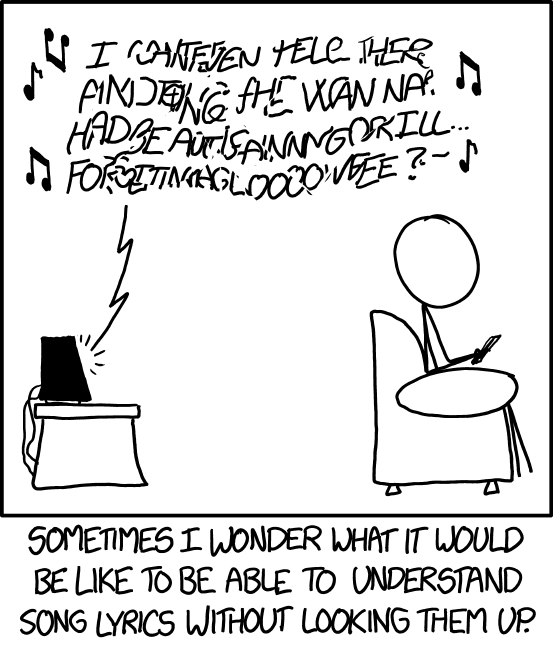
Me. Non native
I’m a non native speaker. First learned it while playing Minecraft, and since I’ve spend multiple hours a day writing and speaking English.
I just spend too much time on the internet
Yup same here
I learned english because i’m deaf and french subtitles were scarse. Futhermore, i always wanted to read the latest scans :)
I learnt it since I was 3. I was literally forced to do it instead of playing outside with my friends. And always out was hard…
Then I found the language Esperanto, that is supposed to be 10x easier to learn and use. I tried it and I can conform that to be true 😊
But I needed English for my (volunteer) work in a social movement, so I slowly learn it. But still had big problems to understand spoken English. Then I found English videos about topic that was very investing for me. I was trying hard to understand and finally I did.
Long story short, I still prefer to speak Esperanto, and much more people should, IMO.
For spoken English, I greatly recommend audiobooks and podcasts. They typically have better narrators, so are easier to understand. As a bonus, one can listen to them while doing household chores and such — for me, consumption of books greatly increased with audiobooks compared to snatches of books here and there.
Absolutely! The videos that helped me to understand English was podcast-like. I am a big fan of audiobooks and podcasts. Mostly to give some rest to my eyes, and to consume them while I am walking outside to protect my physical health.
Oh wow, it’s so cool you speak Esperanto! Can you share your experience with it? Where do you use it? What good Esperanto communities are there? Do you find it actually useful? In what ways did it enrich your life?
BTW a lot of open source programs have Esperanto translations (including Lemmy). Facebook does also for some reason.
One of the reasons that I love free / libre / open source is its high acceptance of Esperanto as an interface language. I myself also helped translate bunch of them (now I am searching for money to pay others to translate them :).
Facebook had a program of volunteer translations years ago. I helped a bit by rating existing translations. Then some law came that prevented for-profit corporations to use volunteers as translators and the program was shut down. Similar with Google, who still has parts of interface in Esperanto. Rumors go that Gmail was once fully translated into Esperanto, but the political decision went to not deploy it…
I’m also in the process of learning Esperanto (there’s actually a decent amount of us on Lemmy)
I don’t foresee it ever being particularly useful on its own, but it is a really easy language to learn, and I think it’s a great way to learn how to learn languages. I feel like after casually teaching myself it for a few years I’m a lot better prepared to learn another language somewhere down the road
There’s a few Esperanto clubs and such out there, I’m not a part of any of them so I can’t really comment on the community all that much.
One thing that does kind of interest me is Pasporta Servo, which is sort of a free Airbnb/couchsurfing thing for esperantists. Seems like that could be a cool way to travel around on the cheap and probably a good way to get more involved in the Esperanto community. Unfortunately most of my traveling is done with my wife and I haven’t been able to convince her to learn Esperanto with me so I doubt she’s gonna want to go hang out with me chatting with someone in a made up language in a foreign land.
Mostly I talk to my dog in it. She knows most of her basic commands in both English and Esperanto.
in a made up language
Aren’t all languages made up?
Yes, all languages are made up. But some are more made up :-)
Constructed vs evolved.
Heh, I am pretty deep embedded in the Esperanto community. I have started 18 years ago and during that time made a lot of friends, some enemies, some love partners (really, we talk together in Esperanto!). In fact, I have founded a nonprofit nongovernmental organisation that support volunteers to write better Wikipedia in Esperanto - and I love the work and it even pays me sometimes. And because of my activities, I have travel around the planet. I live in Europe, and once I have traveled in one month to Seoul, South Korea and Benin and Togo in Africa to Esperanto meetings. That was crazy! During that month I have fulfilled my 2 childhood dreams - to climb a bamboo and to eat a sugar cane ;-)
So, yeah, it enriched my life pretty drastically. I would say that the the biggest long term benefit that I get was wast widening of my horizons. The world became “smaller” for me / more of it became “my home” and I have become more “world citizen”. It may sound cheese but it feels great :-)
There are many local groups over the planet, some event practically every day, many Telegram groups with pretty active community. On Lemmy, there is mostly [email protected]
Very inspiring! I think you convinced me to give it a good try. Thanks for your story and the links!
Cool. For learning Esperanto there is a great site https://lernu.net/ and also Duolingo, and others. After some time came back and comment about your progress, I am interested in your story 😉
Thanks! If I don’t lose Internet access which can happen where I live, I’ll definitely come back XD
yup
I’m Russian, I started learning (school doesn’t count) chatting playing pool at Yahoo.games in the beginning of 2000s.
Then I stopped getting translated versions of games (when I got Morrowind, my head literally hurt due to the amount of “foreign” texts I had to read). So, Internet and games taught me in the beginning.
Then, I was asked to translate at business meetings in my (quite small) company, I did some contract translations as well.
Then I got into IT (like 2012 or so), where you use English in many situations. In 2019, I got into an international company, where I spoke English as a main language for three years. Along the way I moved to Denmark, so now, in addition to my kinda broken English, I have a really shitty Danish.in addition to my kinda broken English, I have a really shitty Danish
Thankfully, not much difference between those, eh.
I’m Indian, specifically Sourh Indian.
We learn English in our schools and it is he main medium for school and college education.I learned the basics from Sonic the Hedgehog and Streets of Rage. Ready… Start! Time up! Game over! Marble zone! All useful phrases when abroad.
For me it was honestly Minecraft since the translations weren’t a thing for a while after its first release (in combination with school)
English is technically my fourth language and I started learning it at age 12. However I really got good around age 16 when I started watching a lot of Hollywood movies with subtitles. Even now when I speak fluent English, with dare I say some “elegance”, i prefer my movies with subtitles, because it’s just a happy place in my mind.
I had to learn English from a young age because it was the primary language used from kindergarten to high school, and even in college.
I improved my comprehension by reading articles and online discussion forums, as well as by watching movies, series, broadcasts, and YouTube videos.
English is my second-ish language, but perhaps I have an unfair advantage for this question since I spent nearly all of my childhood in the US and started learning English at age 5.
It wouldn’t be outwardly noticeable, but the remaining non-native element for me would be the alphabet. I learned the English alphabet well before learning English itself, so the sounds of the individual letters are in my mind still part of my first language. In other words, whenever I recite the alphabet or spell words out loud letter-by-letter, it feels as though I am switching back to my first language.